Our Story · Houston Galleria

Forty-five years of caring for people at home.

Choosing care for your mother or father means trusting someone with the person who raised you. For forty-five years, earning that trust has been the entire point of Homewatch CareGivers, and it is how a small idea from 1980 grew into the team that looks after Houston families today.

Est. 1980 · DenverHouston since 2017Family owned & operated
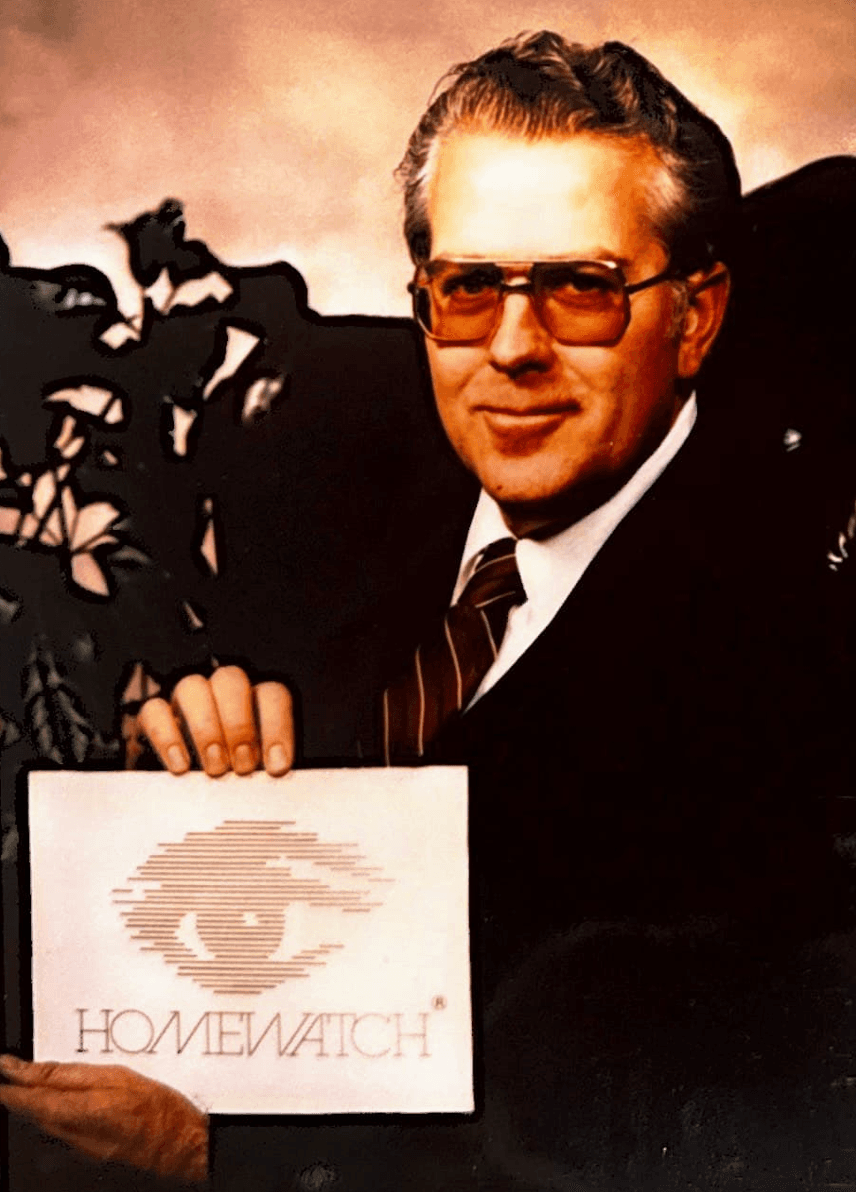
Paul Sauer, founder of Homewatch CareGivers, holding the original Homewatch sign in 1980
Paul Sauer, founder of Homewatch CareGivers, 1980.
The origin Denver, Colorado

It began with a simple conviction.

Homewatch CareGivers began in 1980, when Paul Sauer founded it in Denver, Colorado, on a simple belief: that people growing older, or recovering at home, deserved professional, dependable care delivered with genuine respect.

He built it around what became the company’s enduring principle, person-centered care: care shaped around the individual, their routines, and their dignity, rather than forcing the person to fit the system. More than forty years later, that conviction is still the first thing every Homewatch agency inherits, including ours in Houston.

“I worked in this business until I was seventy-two. That’s how much I loved it, and I still do.”

Sam & Ellen Moreton, who opened the Houston Galleria agency in 2017. Tap to hear from them.
A Houston chapter Houston, Texas

Sam & Ellen brought it home to Houston.

In 2017, Sam and Ellen Moreton opened Homewatch CareGivers of Houston Galleria. A multigenerational Houston family who came to home care after caring for their own aging relatives, they built the agency around a personal approach and real attention to detail.

It worked. They grew the team to roughly 100 caregivers and, by the time they retired in 2024, had earned what few agencies ever do: ranked No. 1 in Houston and No. 7 in the United States.

“We’ve done a lot of things in my life, but I’ve never done anything as rewarding as this one. We change people’s lives.”

Meet the owners Tap a name to read their story

A new generation Houston Galleria

Andrew & Serhat carried it forward, and further.

In December 2024, the agency passed to two Houstonians with very different backgrounds and one shared standard: Andrew Harris, a former Neuro ICU nurse at Houston Methodist, and Serhat Bolukbasi, a former BCG principal. For families, nothing changed, the same caregivers, the same office team, the same care plans. What changed was what stood behind them.

Their promise was simple: protect what was working, and elevate what was possible. Andrew brought the clinical backbone, putting nurse-supervised oversight on every care plan and deepening the agency’s expertise in dementia and Alzheimer’s care. Serhat brought the operating discipline that keeps care dependable and responsive as the team has grown past 200 caregivers.

Both are hands-on, long-term owner-operators, reachable directly, and raising their own families in the same city they serve. Each came to this work for personal reasons, which they tell in their own stories.

“It’s the relationships that matter most. We know every client, their family, even their pets, and that’s what makes our care feel like family.”

What never changes

Forty-five years. One promise.

Different chapters, the same standard. These are the constants families have felt since 1980, and the things we protect as carefully as we grow.

i.

Care shaped around the person

Paul Sauer’s founding idea, person-centered care, still decides how every plan is built. The person comes first; the routine bends to them.

ii.

Personalized, premium service

The standard Sam and Ellen set, treating every family like their own, is the bar we hold ourselves to as we grow.

iii.

Now, supervised by nurses

Today every care plan is overseen by experienced nurses, with a clinical depth in dementia and Alzheimer’s that few agencies can match.

Schedule a private callMeet the whole team →

What ownership actually means for a Houston family

Most home care in the United States is delivered by franchise operators or private equity backed roll-ups where the person who answers the phone has no authority to change the plan, no clinical training to recognise when the plan needs changing, and no financial stake in whether the family stays or leaves after 30 days. Homewatch CareGivers of Houston Galleria is the opposite of that model on purpose. The people whose names are on the licence — Andrew Harris, RN, and Serhat Bolukbasi — are the same people who answer the phone at 9 p.m. on a Sunday when a caregiver is running late, when a client has fallen, or when a family member two thousand miles away needs to talk through something urgent. That is not marketing language; it is how the business is structured.

Andrew’s clinical background is not incidental. He spent his early career as a Neuro ICU nurse at Houston Methodist Hospital, which means the discharge planners at Methodist know him by name, the sequelae of a stroke or a traumatic brain injury are not abstractions to him, and the specific way a post-neurosurgical patient can decompensate at home in the first 72 hours is something he has seen dozens of times. Every care plan that leaves our office crosses his desk. Every high-acuity case is reviewed by him personally. If a client with dementia is refusing care, if a post-hip patient is at risk of a second fall, if a family thinks the plan is not working — the clinical judgement in the room belongs to a registered nurse, not to a scheduler with a checklist.

Serhat’s side of the business is the operational spine. The recruiting funnel that keeps the same faces returning shift after shift. The onboarding that puts every caregiver through paid orientation covering dementia protocols, medication reminders, fall prevention, communication with the family, and the specific documentation habits our Care Managers rely on. The scheduling engine that gives every household a named primary caregiver and a named backup, so a sick day does not become a stranger walking into a client’s home. The measurement discipline that lets us tell a family exactly what percentage of shifts this month were covered by the primary caregiver they know, and to fix the number when it drops.

The scale we run at is deliberate. We are not the largest agency in Houston and we do not want to be. Larger agencies stop being able to keep the founder’s cell phone open to the family, stop being able to have the RN read every plan, stop being able to guarantee that the caregiver who walked in the door on day one is the caregiver still walking in the door on day thirty. We priced the business, staffed it, and drew the service map to keep those things possible. That is what forty-five years of the Homewatch name is meant to protect, and it is what the current ownership means when we tell you the founders’ cell numbers are handed to every family we serve.